
 Honda Accord: Using a Booster Seat
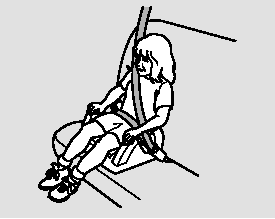
A child who has outgrown a forwardfacing child seat should ride in a back seat and use a booster seat until the lap/shoulder belt fits them properly without the booster.
Some states, Canadian provinces and territories also require children to use a booster seat until they reach a given age or weight (e.g., 6 years or 60 lbs). Be sure to check current laws in the states, provinces or territories where you intend to drive.
Booster seats can be high-back or low-back. Whichever style you select, make sure the booster seat meets federal safety standards and that you follow the booster seat maker’s instructions.
If a child who uses a booster seat must ride in front, move the vehicle seat as far back as possible and be sure the child is wearing the seat belt properly.
A child may continue using a booster seat until the tops of their ears are even with the top of the vehicle’s or booster’s seat-back. A child of this height should be tall enough to use the lap/shoulder belt without a booster seat.
 Checking Seat Belt Fit
To determine if a lap/shoulder belt
properly fits a child, have the child
put on the seat belt, then ask
yourself:
1. Does the child sit all the way back
against the seat?
2. Do the childâ ...
 When Can a Larger Child Sit in Front
The National Highway Traffic Safety
Administration and Transport
Canada recommend that all children
aged 12 and under be properly
restrained in a back seat.
If the passenger’s front airbag ...
See also:
Motor Test
1. Remove the front seat back panel, and seat-back
cover/pad.
• 4-door (see page 20-221)
• 2-door (see page 20-213)
2. Disconnect the 2P connector (A) from the lumbar
support motor (B ...
Test/Replacement
EX-L, EX-L PZEV models
1. Remove the cover (A), then disconnect BP connector
(B).
2. Turn the ignition switch to ON (II).
3. Measure the voltage between terminal No. 2 and
body ground.
вÐ ...
Block and Piston inspection
1. Remove the crankshaft and the pistons (see page
7-14).
2. Check the piston for distortion or cracks.
3. Measure the piston diameter at a point 13 mm (0.5 in)
from the bottom of the skirt. T ...