
 Honda Accord: Door Position Adjustment
NOTE: Check for a flush fit with the body, then check for equal gaps between the front, rear, and bottom door edges and the body. Check that the door and body edges are parallel.
1. Place the vehicle on a firm, level surface when adjusting the doors.
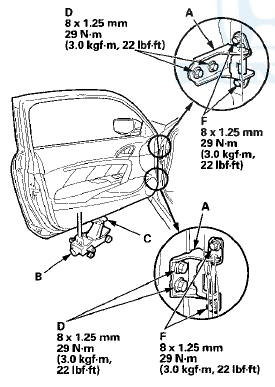
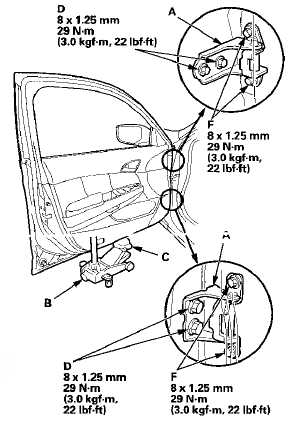
2. Adjust at the hinges (A): - Pad a floor jack (B) with shop towels (C), then use the jack to support the door while adjusting it.
- On the front door: Remove the front inner fender (see page 20-290). Loosen the hinge mounting bolts (D) slightly, and move the door backward or forward, up or down as necessary to equalize the gaps.
- On the rear door: Loosen the hinge mounting bolts (E) slightly, and move the door backward or forward, up or down as necessary to equalize the gaps.
2-door
4-door front
4-door rear
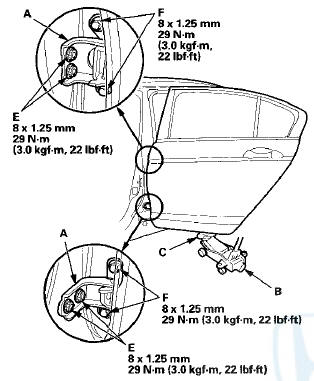
3. If necessary, replace the door mounting bolts with the adjusting bolts made specifically for door adjustment, then adjust at the door: Loosen the door mounting bolts (F) slightly, and move the door up or down as necessary to equalize the gaps, and move it in or out until is not flush with the body.
NOTE: Refer to the Parts Catalog if you need use an adjusting bolt.
4. Check that the door and the body edges are parallel. If necessary, adjust the door cushions (A) to make the rear of the doors flush with the body.
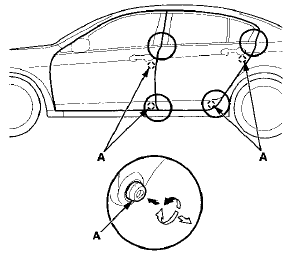
5. Apply touch-up paint to the hinge mounting bolts, and around the hinges.
6. Check for water leaks (see step 9 on page 20-57).
 Door Glass Adjustment
NOTE: Check the door weatherstrip and the glass run
channel for damage or deterioration, and replace them if
necessary.
1. Place the vehicle on a firm, level surface when
adjusting the door glas ...
 Door Striker Adjustment
Make sure the door latches securely without slamming
it. If necessary, adjust the striker (A): The striker nuts are
fixed, but the striker can be adjusted slightly up or down,
and in or out.
1. ...
See also:
VSA Off Switch Test
1. Turn the ignition switch to LOCK (0).
2. Remove the driver's dashboard lower cover {see page
20-166).
3. Push out the VSA OFF switch (A) from the driver's
dashboard lower cover.
4. Check ...
Tire Pressure Sensor Location
Special Tools Required
TPMS Trigger Tool ATEQ VT55*
*Available through the Honda Tool and
Equipment
Program 888-424-6857
NOTE:
- The TPMS tool is necessary to do this procedure.
- Let the ve ...
Mode Control Motor Replacement
1. Remove the blower unit (see page 21-65).
2. Disconnect the 7P connector (A) from the mode
control motor (B). Remove the self-tapping screws
and the mode control motor from the heater unit.
...