
 Honda Accord: Expansion Valve Replacement
1. Remove the evaporator core (see page 21-67).
2. Remove the insulator (A) and bolts, then remove the expansion valve (B) and O-rings (C).
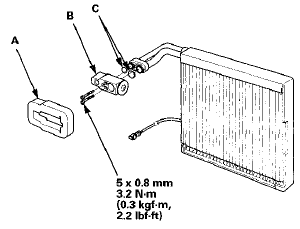
3. Install the expansion valve in the reverse order of removal, and note these items: • Replace the O-rings with new ones at each fitting, and apply a thin coat of refrigerant oil before installing them. Be sure to use the correct O-rings for HFC-134a (R-134a) to avoid leakage.
•immediately after using the oil, reinstall the cap on the container, and seal it to avoid moisture absorption.
• Do not spill the refrigerant oil on the vehicle; it may damage the paint; if the refrigerant oil contacts the paint, wash it off immediately.
• Make sure that there is no air leakage.
• Charge the system (see page 21-81).
 Evaporator Core Replacement
1. Recover the refrigerant with a
recovery/recycIing/charging station (see page 21-80).
2. Remove the bolt from the A/C line clamp (A).
3. Remove the bolt, then disconnect the A/C line (A)
fro ...
 Heater Unit/Core Replacement
SRS components are located in this area. Review the
SRS component locations (see page 24-21) and the
precautions and procedures (see page 24-25) before
doing repairs or service.
1. Do the batter ...
See also:
Countershaft Reverse Selector Hub and
3rd Gear Removal
1. Install a commercially available bearing separator on
4th gear (A). Set the countershaft (B) on a press with a
spacer (C) between the press and the countershaft,
and remove the reverse selector ...
Front Seat Belt Replacement
Front Seat Belt - 2-door
SRS components are located in this area. Review the
SRS component locations (see page 24-23) and the
precautions and procedures (see page 24-25) before
doing repairs or se ...
Reverse Lockout
6-speed manual transmission only
The manual transmission has a
lockout so you cannot accidentally
shift from any forward gear to
reverse while the vehicle is moving
at a certain speed. If you ...