 Honda Accord: ThreeWay Catalytic Converters
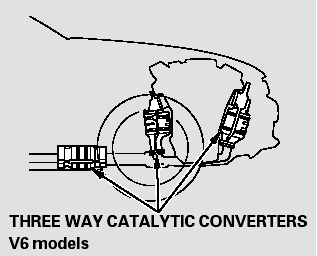
The three way catalytic converters contain precious metals that serve as catalysts, promoting chemical reactions to convert the exhaust gasses without affecting the metals.
The catalytic converters are referred to as three-way catalysts, since they act on HC, CO, and NOx.
Replacement units must be original Honda parts or their equivalent.
The three way catalytic converters must operate at a high temperature for the chemical reactions to take place. They can set on fire any combustible materials that come near them. Park your vehicle away from high grass, dry leaves, or other flammables.
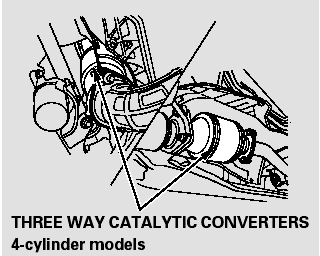
Defective three way catalytic converters contribute to air pollution, and can impair your engine’s performance. Follow these guidelines to protect your vehicle’s three way catalytic converters.
Always use unleaded gasoline.
Even a small amount of leaded gasoline can contaminate the catalyst metals, making the three way catalytic converters ineffective.
Keep the engine well maintained.
Have your vehicle diagnosed and repaired if it is misfiring, backfiring, stalling, or otherwise not running properly.
 Emissions Controls
The burning of gasoline in your
vehicle’s engine produces several byproducts.
Some of these are carbon
monoxide (CO), oxides of nitrogen
(NOx), and hydrocarbons (HC).
Gasoline evaporating fr ...
 Emissions Testing
Testing of Readiness Codes
If you take your vehicle for an
emissions test shortly after the
battery has been disconnected or
gone dead, it may not pass the test.
This is because of certain ‘ ...
See also:
Steering Angle Sensor Replacement
SRS components are located In this area. Review the SRS component locations:
4-door (see page 24-21), 2-door (see
page 24-23) and the precautions and procedures (see page 24-25).
NOTE: Do not da ...
Receiving XM Radio Service
If your XM Radio service has expired
or you purchased your vehicle from
a previous owner, you can listen to a
sampling of the broadcasts available
on XM Radio. With the ignition
switch in th ...
Checking Wiper Blades
If the wiper blade rubber has deteriorated, it will leave streaks and the
metal wiper
arm may scratch the window glass. ...