
 Honda Accord: Stabilizer Bar Replacement
1. Raise and support the vehicle (see page 1-13).
2. Remove the rear wheels.
3. Disconnect both stabilizer links from the stabilizer bar (see page 18-47).
4. Remove the flange bolts (A) and the bushing holders (B), then remove the bushings (C) and the stabilizer bar (D).
NOTE: During installation, align the paint marks (E) on the stabilizer bar with the side of the bushings.
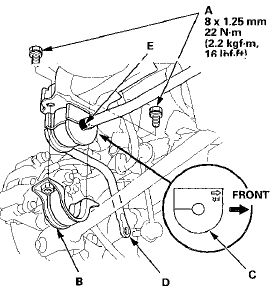
5. Install the stabilizer bar in the reverse order of removal, and note these items: - Note the right and left direction of the stabilizer bar.
- Note the direction of installation for the bushing.
- Refer to the stabilizer link removal/installation to connect the stabilizer bar to the links (see page 18-47).
- Before installing the wheel, clean the mating surfaces of the brake disc and the inside of the wheel.
 Stabilizer Link Removal/Installation
1. Raise and support the vehicle (see page 1 -13).
2. Remove the rear wheel.
3. Remove the flange nut (A) and the self-locking nut (B)
while holding the respective joint pin (C) with a hex
wre ...
 Damper/Spring Removal and Installation
Removal
1. Raise and support the vehicle (see page 1-13).
2. Remove the rear wheel.
3. Fold down the rear seat-back, then remove the lid (A).
NOTE: For 4-door, lift up the tab (B) inside und ...
See also:
To Play an iPod
This audio system can select and
play the audio files on the iPod with
the same controls used for the disc
player. To play an iPod, connect it to
the USB adapter cable in the console
compart ...
How the Side Airbag Off Indicator Works
This indicator alerts you that the
passenger’s side airbag has been
automatically shut off. It does not
mean there is a problem with your
side airbags.
When you turn the ignition switch t ...
Playing Internet Radio
Connect a compatible phone through Bluetooth®.
You can also connect the phone using your dock connector to the USB port.
Make sure the audio setting is correct for the connection type.
Press t ...