
 Honda Accord: Throttle Body Test
Carbon Accumulation Check
NOTE: If the malfunction indicator lamp (MIL) has been reported on, check for diagnostic trouble codes (DTCs).
1. Connect the HDS to the data link connector (DLC) (A) located under the driver's side of the dashboard.
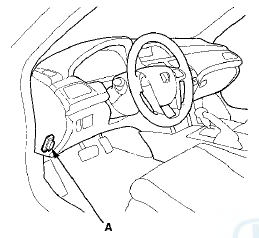
2. Turn the ignition switch to ON (II).
3. Make sure the HDS communicates with the ECM/PCM. If it doesn't, go to the DLC circuit troubleshooting (see page 11-181).
4. Start the engine. Hold the engine speed at 3,000 rpm without load (A/T in P or N, M/T in neutral) until the radiator fan comes on, then let it idle.
5. Check the REL TP SENSOR in the DATA LIST with the HDS. The reading should be below 2.46 percent. If it is not, clean the throttle body (see page 11-332).
Throttle Position Learning Check
NOTE: If the malfunction indicator lamp (MIL) has been reported on, check for diagnostic trouble codes (DTCs).
1. Connect the HDS to the data link connector (DLC) (A) located under the driver's side of the dashboard.
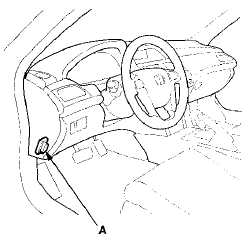
2. Turn the ignition switch to ON (II).
3. Make sure the HDS communicates with the ECM/PCM. If it doesn't, go to the DLC circuit troubleshooting (see page 11-181).
4. Select the INSPECTION MENU with the HDS.
5. Do the TP POSITION CHECK in the ETCS TEST. If needed, clean the throttle body (see page 11-332).

 Throttle Body Cleaning
Do n o t i n s e r t : your fingers into the installed throve
body when you turn the ignition switch to ON (II) or
while the ignition switch is in ON (II). If you do, you
will seriously injure your ...
See also:
Transferring a Call
You can transfer a call from HFL to
your phone, or from your phone to
HFL.
Press and release the HFL Talk
button and say ‘‘Transfer.’’ ...
Features
The heating and air conditioning
system in your vehicle provides a
comfortable driving environment in
all weather conditions.
The standard audio system has
many features. This section
descr ...