
 Honda Accord: Refrigerant Recovery
• Air conditioning refrigerant or lubricant vapor can irritate your eyes, nose, or throat.
• Be careful when connecting service equipment.
•Do not breathe refrigerant or vapor.
NOTE: .
• If accidental system discharge occurs, ventilate the work area before resuming service.
• Additional health and safety Information may be obtained from the refrigerant and lubricant manufacturers.
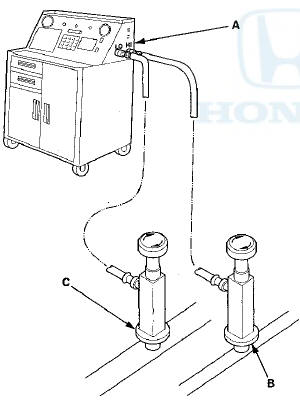
1. Connect an R-134a refrigerant recovery/recyeling/charging station (A) to the high-pressure service port (B) and the low-pressure service port (C), as shown, following the equipment manufacturer's instructions.
2. Measure the amount of refrigerant oil removed from the A/C system after the recovery process is completed. Be sure to put the same amount of new refrigerant oil back into the A/C system before charging.
 Dust and Pollen Filter Replacement
1. Open the glove box. Remove the glove box stop on
the right side, then let the glove box hang down (see
page 20-174).
2. Remove the dust and pollen filter assembly (A) from
the blower unit.
...
 System Evacuation
• Air conditioning refrigerant or lubricant v a p o r c an
irritate your eyes, nose, or throat.
•Be careful when connecting service
equipment.
• Do not breathe refrigerant or v ...
See also:
Audio with Touch Screen
Use the touch screen to operate the audio system.
• Selecting an Audio Source
Select Source, then select an icon on the source list to switch the
audio source.
• Displaying the Menu Items
...
Driver's Dashboard Lower Cover
Removal/Installation
Special Tools Required
KTC Trim Tool Set SOJATP2014*
* Available through the Honda Tool and
Equipment
Program; call 888-424-6857
NOTE;
- Take care not to scratch the dashboard or the related
p ...
Center Console Removal/Installation
NOTE:
- Put on gloves to protect your hands.
- Take care not to scratch the front seat, the dashboard,
or the related parts.
1 . Remove these items:
- Center console panel (see page 20-157)
...