
 Honda Accord: Front Brake Caliper Overhaul
Frequent inhalation of brake pad dust, regardless of material composition, could be hazardous to your health.
- Avoid breathing dust particles.
- Never use an air hose or brush to clean brake assemblies. Use an OSHA-approved vacuum cleaner.
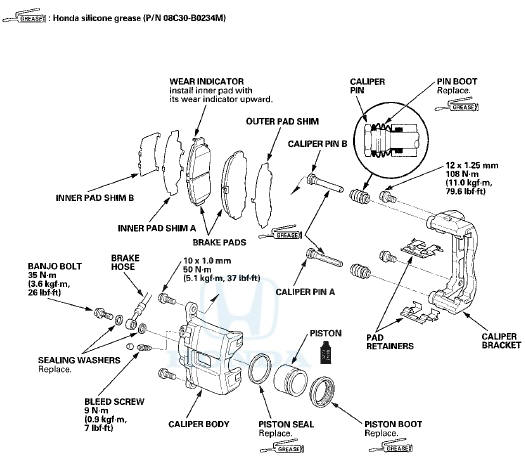
NISSIN T y p e
Remove, disassemble, inspect, reassemble, and install the caliper, and note these items: NOTE: Make sure that the caliper pins are installed correctly. Upper caliper pin B and lower caliper pin A are different If these caliper pins are installed in the wrong location, it will cause vibration, uneven or rapid brake pad wear, and possibly uneven tire wear.
- Do not spill brake fluid on the vehicle; it may damage the paint. If brake fluid gets on the paint, wash it off immediately with water.
- To prevent dripping brake fluid, cover disconnected hose joints with clean rags or shop towels.
- Clean all parts in brake fluid and air dry; blow out all passages with compressed air.
- Replace parts with new ones as specified in the illustration.
- Make sure no dirt or other foreign matter gets in the brake fluid.
- Make sure no grease or oil gets on the brake discs or the pads.
- When reusing brake pads, always reinstall them in their original positions to prevent loss of braking efficiency.
- Do not reuse drained brake fluid. Use only new Honda DOT 3 Brake Fluid from an unopened container. Using a non-Honda brake fluid can cause corrosion and shorten the life of the system.
- Coat the piston, the piston seal groove, and the caliper bore with clean brake fluid.
- Use recommended greases in the front caliper set.
- After installing the caliper, check the brake hose and line for leaks, interference, and twisting.
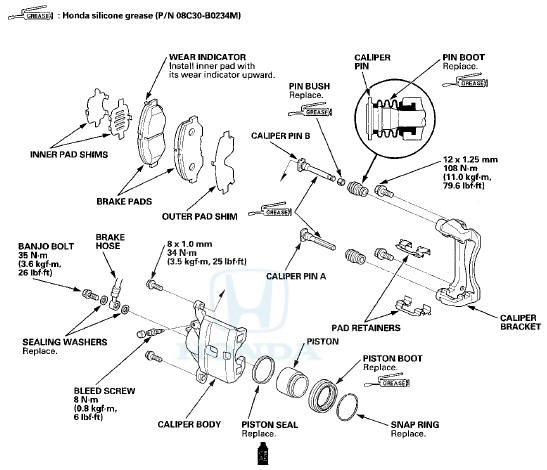
AKEBOMO Type
Remove, disassemble, inspect, reassemble, and install the caliper, and note these items: NOTE: Make sure that the caliper pins are installed correctly. Upper caliper pin B and lower caliper pin A are different. If these caliper pins are installed in the wrong location, it will cause vibration, uneven or rapid brake pad wear, and possibly uneven tire wear.
- Do not spill brake fluid on the vehicle; it may damage the paint. If brake fluid gets on the paint, wash it off immediately with water.
- To prevent dripping brake fluid, cover disconnected hose joints with clean rags or shop towels.
- Clean all parts in brake fluid and air dry; blow out all passages with compressed air.
- Before reassembling, check that all parts are free of dirt and other foreign particles.
- Replace parts with new ones as specified in the illustration.
- Make sure no dirt or other foreign matter gets in the brake fluid.
- Make sure no grease or oil gets on the brake discs or the pads.
- When reusing brake pads, always reinstall them in their original positions to prevent loss of braking efficiency.
- Do not reuse drained brake fluid. Use only new Honda DOT 3 Brake Fluid from an unopened container. Using a non-Honda brake fluid can cause corrosion and shorten the life of the system.
- Coat the piston, the piston seal groove, and the caliper bore with clean brake fluid.
- Use recommended greases in the front caliper set.
- After installing the caliper, check the brake hose and line for leaks, interference, and twisting.
 Front Brake Disc Replacement
NOTE: Keep any grease off the brake disc and the brake
pads.
1. Raise and support the vehicle (see page 1 -13).
2. Remove the front wheel.
3. Remove the brake hose mounting bolt (A).
4. R ...
 Master Cylinder Replacement
- Do not spill brake fluid on the vehicle; It may damage
the paint. If brake fluid gets on the paint, wash It off
Immediately with water.
- Be careful not to damage or bend the brake lines
dur ...
See also:
Oil Filter Feed Pipe Replacement
1. Remove the oil filter base (see page 8-13).
2. Remove the oil filter feed pipe.
3. Install the two 20 x 1.5 mm nuts (A) onto the new oil
filter feed pipe. Hold one nut with a wrench, then us ...
Accessories and Modifications
Modifying your vehicle, or installing
some non-Honda accessories, can
make your vehicle unsafe. Before
you make any modifications or add
any accessories, be sure to read the
following inform ...
Using the Trunk Opener
Pulling the trunk release to the lower left of
the driver's seat unlocks and opens the trunk.
• Locking the trunk opener
You can lock the trunk release with the master
key* or the built-in ...