
 Honda Accord: Evaporator Temperature Sensor Test
NOTE: Before testing the sensor, check for HVAC DTCs (see page 2 1 - 9).
1. Remove the evaporator temperature sensor (see page 21-67).
2. Dip the sensor in ice water, and measure the resistance between its terminals.
EVAPORATOR TEMPERATURE SENSOR
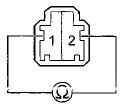
Terminal side of male terminals
3. Pour warm water on the sensor, and check for a change in the resistance.
4. Compare the resistance readings with the specifications shown in the graph; the resistance should be within the specifications.
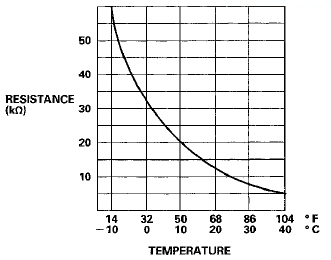
5. If the resistance is not as specified, replace the evaporator temperature sensor (see page 21-67).
 A/C Signal Circuit Troubleshooting
NOTE:
• If the blower motor does not run at all speeds, the A/C
compressor will be inoperative. Run the
self-diagnostic function, and check for DTC 12. Before
performing any other troubleshoo ...
 Power Transistor Test
1. Remove the passenger's dashboard undercover (see
page 20-170).
2. Disconnect the 4P connector from the power
transistor.
3. Measure the resistance between terminals No. 3 and
No. 4 of the ...
See also:
Forward Collision Warning (FCW)*
Alerts you when it detects the possibility of your vehicle colliding with the
vehicle in
front of yours.
If the system determines a collision is possible, it gives both visual and
audible alert ...
Connector Index
Identification numbers have been assigned to in-line connectors, junction
connectors, and terminals. The number is preceded by the letter "C"
for connectors, " G " for ground te ...
Starter Removal and
Installation
Removal
1 Do the battery removal procedure (see page 22-92).
2. Remove the intake manifold (see page 9-4).
3. Disconnect the positive starter cable (A) from the B
terminal, and the S terminal ...