
 Honda Accord: Opening and Closing the Hood
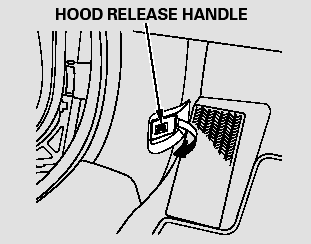
1. Park the vehicle, and set the parking brake. Pull the hood release handle located under the lower left corner of the dashboard.
The hood will pop up slightly.
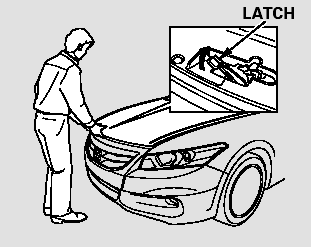
2. Reach in between the hood and the front grille with your fingers.
The hood latch handle is above the ‘‘H’’ logo. Push this handle up until it releases the hood. Lift the hood.
If the hood latch handle moves stiffly, or if you can open the hood without lifting the handle, the mechanism should be cleaned and lubricated.
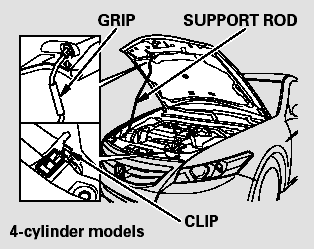
3. 4-cylinder models
Holding the grip, pull the support rod out of its clip. Insert the end into the hole in the hood designated by an arrow.
To close the hood, lift it up slightly to remove the support rod from the hole. Put the support rod back into its holding clip. Lower the hood to about a foot (30 cm) above the fender, then let it drop. Make sure it is securely latched.
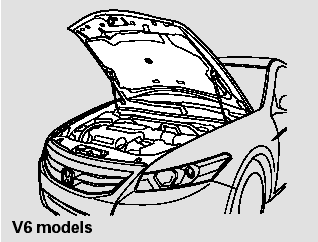
V6 models
Lift the hood up most of the way.
The hydraulic supports will lift it up the rest of the way and hold it up.
To close the hood, lower it to about a foot (30 cm) above the fender, then press down firmly with your hands. Make sure the hood is securely latched.
 Check Fuel Cap Message
Your vehicle’s onboard diagnostic
system will detect a loose or missing
fuel fill cap as an evaporative system
leak. The first time a leak is detected
a ‘‘CHECK FUEL CAP’’ message ...
 Oil Check
Wait a few minutes after turning the
engine off before you check the oil.
1. Remove the dipstick (orange
handle/loop).
2. Wipe off the dipstick with a clean
cloth or paper towel.
3. Inser ...
See also:
Rear License Plate Light Bulbs
When replacing, use the following bulbs.
1. Remove the license plate light assembly by
pushing the left edge of the lens toward the
right and pulling the assembly out.
2. Remove the lens b ...
Tire Maintenance
In addition to proper inflation,
correct wheel alignment helps to
decrease tire wear. If you find a tire
is worn unevenly, have your dealer
check the wheel alignment.
Have your dealer check t ...
To Use Maintenance MinderTM
• Displaying the Engine Oil Life
1. Set the power mode to ON.
2. Press the (Information) button
repeatedly until the engine oil life appears
on the multi-information display.
Based on the ...