
 Honda Accord: Transmission Fluid Pressure Switch B
(3rd Clutch) Replacement
Honda Accord: Transmission Fluid Pressure Switch B
(3rd Clutch) Replacement
1. Raise the vehicle on a lift, or apply the parking brake, block both rear wheels, and raise the front of the vehicle. Make sure it is securely supported.
2. Remove the splash shield.
3. Disconnect the connector (A) from the transmission fluid pressure switch B {3rd clutch) (B), then remove the transmission fluid pressure switch B (3rd clutch).
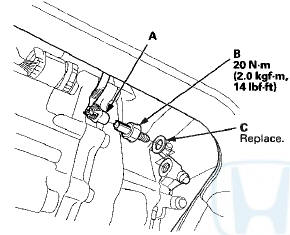
4. Install a new transmission fluid pressure switch B (3rd clutch) with a new sealing washer (C), and tighten the transmission fluid pressure switch B (3rd clutch) to the specified torque by turning the metal part, not the plastic part.
5. Check the connector for rust, dirt, or oil, and clean or repair if necessary, then connect the connector securely.
6. Install the splasTi shield.
 Transmission Fluid Pressure Switch A
(2nd Clutch) Replacement
Transmission Fluid Pressure Switch A
(2nd Clutch) Replacement
1. Remove the intake air duct.
2. Disconnect the connector (A) from the transmission
fluid pressure switch A (2nd clutch) (B), and remove
the transmission fluid pressure switch A (2nd clutch).
...
 ATF Temperature Sensor
Test/Replacement
ATF Temperature Sensor
Test/Replacement
1. Raise the vehicle on a lift, or apply the parking brake,
block both rear wheels, and raise the front of the
vehicle. Make sure it is securely supported.
2. Remove the splash shield.
3. Disc ...
See also:
Daytime Running Lights
With the headlight switch off or in
the
position, the high beam
headlights and the high beam
indicator come on with reduced
brightness when you turn the
ignition switch to the ON (II)
po ...
Information Display
Information Display
The information display shows the
odometer, trip meter, engine oil life,
outside temperature (if equipped),
and maintenance item code(s).
To switch the display, press and ...
Wiper Motor Replacement
Removal
1. Open the hood. Remove the caps (A) and nuts (B).
NOTE: The illustration shows 4-door.
2. Close the hood, then spread protective cloths (A) on
the hood to avoid scratching the hood e ...