
 Honda Accord: The Passenger’s Front Airbag Can Pose Serious Risks
Front airbags have been designed to help protect adults in a moderate to severe frontal collision. To do this, the passenger’s front airbag is quite large, and it can inflate with enough force to cause very serious injuries.
Even though your vehicle has an advanced front airbag system that automatically turns the passenger’s front airbag off under certain circumstances, please follow these guidelines:
Infants
Never put a rear-facing child seat in the front seat of a vehicle equipped with a passenger’s front airbag. If the airbag inflates, it can hit the back of the child seat with enough force to kill or very seriously injure an infant.
Small Children
Placing a forward-facing child seat in the front seat of a vehicle equipped with a passenger’s front airbag can be hazardous. If the vehicle seat is too far forward, or the child’s head is thrown forward during a collision, an inflating front airbag can strike the child with enough force to kill or very seriously injure a small child.
Larger Children
Children who have outgrown child seats are also at risk of being injured or killed by an inflating passenger’s front airbag.
Whenever possible, larger children should sit in the back seat, on a booster seat if needed, and be properly restrained with a seat belt (see for important information about protecting larger children).
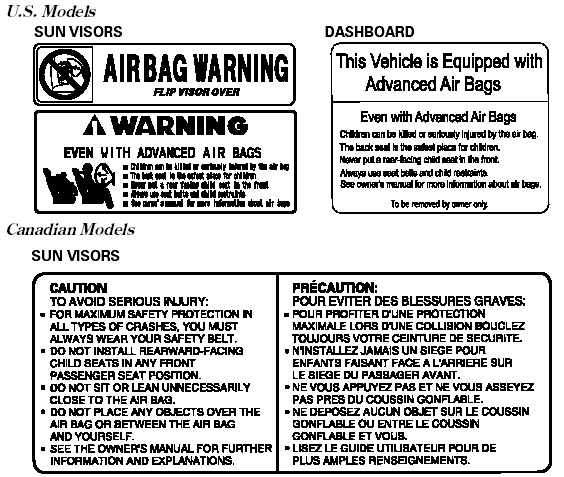
To remind you of the passenger’s front airbag hazards, and that children must be properly restrained in a back seat, your vehicle has warning labels on the dashboard (U.S. models) and on the front visors.
Please read and follow the instructions on these labels.
 All Children Should Sit in a Back Seat
According to crash statistics,
children of all ages and sizes are
safer when they are restrained in a
back seat.
The National Highway Traffic Safety
Administration and Transport
Canada reco ...
 If YouMust Drive with Several Children
Your vehicle has a back seat where
children can be properly restrained.
If you ever have to carry a group of
children, and a child must ride in
front:
Place the largest child in the front
se ...
See also:
Trunk Light Test/Replacement
1. Open the trunk lid.
2. Carefully pry out the trunk light (A).
Trunk Light: 5 W
3. Disconnect the 2P connector (B) from the trunk light.
4. Check for continuity between terminals No. 1 ( + ...
Driving Position Memory System*
You can store two driver’s seat positions with the driving position memory
system.
When you unlock and open the driver’s door with a remote, the seat adjusts
automatically to one of the two ...
Replacing a Headlight Bulb
Your vehicle has halogen headlight
bulbs. When replacing a bulb, handle
it by its base, and protect the glass
from contact with your skin or hard
objects. If you touch the glass, clean
it wi ...