
 Honda Accord: Protecting Small Children
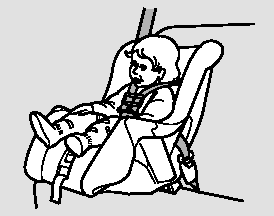
Child Seat Type
Many states, Canadian provinces and territories allow a child one year of age or older who also meets the minimum size and weight requirements to transition from a rear-facing child seat to a forward facing seat. Know the requirements where you are driving and follow the child seat instructions. Many experts recommend use of a rear-facing seat up to age two, if the child’s height and weight are appropriate for a rear-facing seat.
Of the different seats available, we recommend those that have a fivepoint harness system as shown.
We also recommend that a small child use the child seat until the child reaches the weight or height limit for the seat.
Child Seat Placement
We strongly recommend placing a forward-facing child seat in a back seat, not the front.
Placing a forward-facing child seat in the front seat of a vehicle equipped with a passenger’s airbag can be hazardous. If the vehicle seat is too far forward, or the child’s head is thrown forward during a collision, an inflating airbag can strike the child with enough force to cause very serious or fatal injuries.
Even with advanced front airbags that automatically turn the passenger’s front airbag off, a back seat is the safest place for a small child.
If it is necessary to put a forwardfacing child seat in the front, move the vehicle seat as far to the rear as possible, and be sure the child seat is firmly secured to the vehicle and the child is properly strapped in the seat.

Placing a forward-facing child seat in the front seat can result in serious injury or death if the front airbag inflates.
If you must place a forwardfacing child seat in front, move the vehicle seat as far back as possible, and properly restrain the child.
 Protecting Infants
Child Seat Type
An infant must be properly
restrained in a rear-facing, reclining
child seat until the child reaches the
seat maker’s weight or height limit
for the seat, and the child is ...
 Selecting a Child Seat
When buying a child seat, you need
to choose either a conventional child
seat, or one designed for use with
the Lower Anchors and Tethers for
CHildren (LATCH) system.
Conventional child seats ...
See also:
Immobilizer-Keyless Control Unit
Replacement
1 . Remove the driver's dashboard lower cover (see page
20-166).
2. Remove the steering column covers (see page
20-181).
3. Disconnect the 7P connector (A) from the
immobilizer-keyless contro ...
Frame Repair Chart
Top View
g2 Front floor locating hole 025 (0.98) rear
h2 Front floor tunnel frame locating hole 013 (0.51) rear
i Rear frame A locating hole 025 (0.98)
j Rear floor locating hole 025 (0.98)
k1 ...