
 Honda Accord: Overheating
How to Handle Overheating
Overheating symptoms are as follows:
• The temperature gauge needle is at the
 mark or the engine suddenly loses
power.
mark or the engine suddenly loses
power.
• Steam or spray comes out of the engine compartment.
• First thing to do
1. Immediately park the vehicle in a safe place.
2. Turn off all accessories and turn on the hazard warning lights.
- No steam or spray present: Keep the engine running and open the hood.
- Steam or spray is present: Turn off the engine and wait until it
subsides.
Then open the hood.
WARNING
Steam and spray from an overheated engine can seriously scald you.
Do not open the hood if steam is coming out.
NOTICE
Continuing to drive with the temperature gauge
needle at the mark may damage the
engine.
• Next thing to do
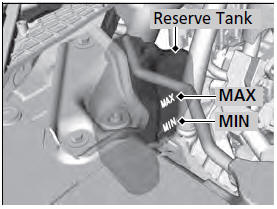
1. Check that the cooling fan is operating and
stop the engine once the temperature
gauge needle comes down.
- If the cooling fan is not operating,
immediately stop the engine.
2. Once the engine has cooled down, inspect
the coolant level and check the cooling
system components for leaks.
- If the coolant level in the reserve tank is
low, add coolant until it reaches the
MAX mark.
- If there is no coolant in the reserve tank,
check that the radiator is cool. Cover the
radiator cap with a heavy cloth and open
the cap. If necessary, add coolant up to
the base of the filler neck, and put the
cap back on.
WARNING
Removing the radiator cap while the engine is hot can cause the coolant to spray out, seriously scalding you.
Always let the engine and radiator cool down before removing the radiator cap.
If the coolant is leaking, contact a dealer for repairs.
Use water as an emergency/temporary measure only.
Have a dealer flush the system with proper antifreeze as soon as possible.
• Last thing to do
Once the engine has cooled sufficiently, restart it and check the temperature gauge.
If the temperature gauge needle has gone down, resume driving. If it has not gone down, contact a dealer for repairs.
 Shift Lever Does Not Move
Follow the procedure below if you cannot move the shift lever out of the
position.
• Releasing the Lock
1. Set the parking brake.
2. Remove the key from the ignition switch.
2. Remove ...

See also:
Fan Controls
Component Location Index
Symptom Troubleshooting Index
'08-09 models
10 model
Circuit Diagram
'08-09 models
'10 model
Radiator Fan Circuit Troubleshooting
'08-09 models
1 ...
Symptom Troubleshooting
Information
General Check Before Troubleshooting
Before troubleshooting the immobilizer system, check the following general
items and solve any if applicable:
• The battery is low; charge the battery ful ...
Front Door Weatherstrip Replacement
NOTE:
- Put on gloves to protect your hands.
- Take care not to scratch the door.
- Take care not to damage the front upper corner clip
(black) (4-door) and the rear upper corner clips (black) ...