
 Honda Accord: Ignition Timing Inspection
1. Connect the Honda Diagnostic System (HDS) to the data link connector (DLC) (see step 2 on page 11-3).
2. Turn the ignition switch to ON (II).
3. Make sure the HDS communicates with the vehicle and the engine control module (ECM)/powertrain control module (PCM). If it does not communicate, troubleshoot the DLC circuit (see page 11-181).
4. Check for DTCs (see page 11-3). If a DTC is present, diagnose and repair the cause before continuing with this test.
5. Start the engine. Hold the engine speed at 3,000 rpm with no load (in N or P (A/T model) or neutral (M/T model)) until the radiator fan comes on, then let it idle.
6. Check the idle speed (see page 11-292).
7. Jump the SCS line with the HDS.
NOTE: This step must be done to protect the ECM/PCM from damage.
8. Connect the timing light to the service loop (white tape).
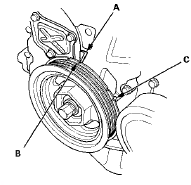
9. Aim the light toward the pointer (A) on the cam chain case. Check the ignition timing under a no load condition (headlights, blower fan, rear window defogger, and air conditioner are turned off).
NOTE: The other pointer (C) is not used.
Ignition Timing:
M/T model: 8 Р’В± 2 Р’В°BTDC (RED mark (B)) at idle in neutral
A/T model: 8 Р’В± 2 Р’В°BTDC (RED mark (BР’В» at idle in NorP
10. If the ignition timing differs from the specification, check the cam timing. If the cam timing is OK, update the ECM/PCM if it does not have the latest software (see page 11-203), or substitute a known-good ECM/PCM (see page 11-7), then recheck. If the system works properly, and the ECM/PCM was substituted, replace the original ECM/PCM (see page 11-204).
11. Disconnect the HDS and the timing light.

 Ignition Coil and Spark Plug
Removal/Installation
Ignition Coil and Spark Plug
Removal/Installation
1. Remove the ignition coil cover (A).
2. Disconnect the ignition coil connectors (B), then
remove the ignition coils (C).
3. Remove the spark plug and inspect them (see page
4-20).
4. Appl ...
See also:
Clutch Master Cylinder Replacement
NOTE:
- Use fender covers to avoid damaging
painted
surfaces.
- Do not spill brake fluid on the vehicle; it may damage
the paint or plastic. If brake fluid does contact the paint
or plastic, ...
Wear Indicators
The groove where the wear indicator is
located is 1/16 inch (1.6 mm) shallower than
elsewhere on the tire. If the tread has worn so
that the indicator is exposed, replace the tire.
Worn out ...
Adding Engine Oil
1. Unscrew and remove the engine oil fill cap.
2. Add oil slowly.
3. Reinstall the engine oil fill cap, and tighten
it securely.
4. Wait for three minutes and recheck the
engine oil dipsti ...